Small Is Beautiful - A Study Of Economics As If People Mattered
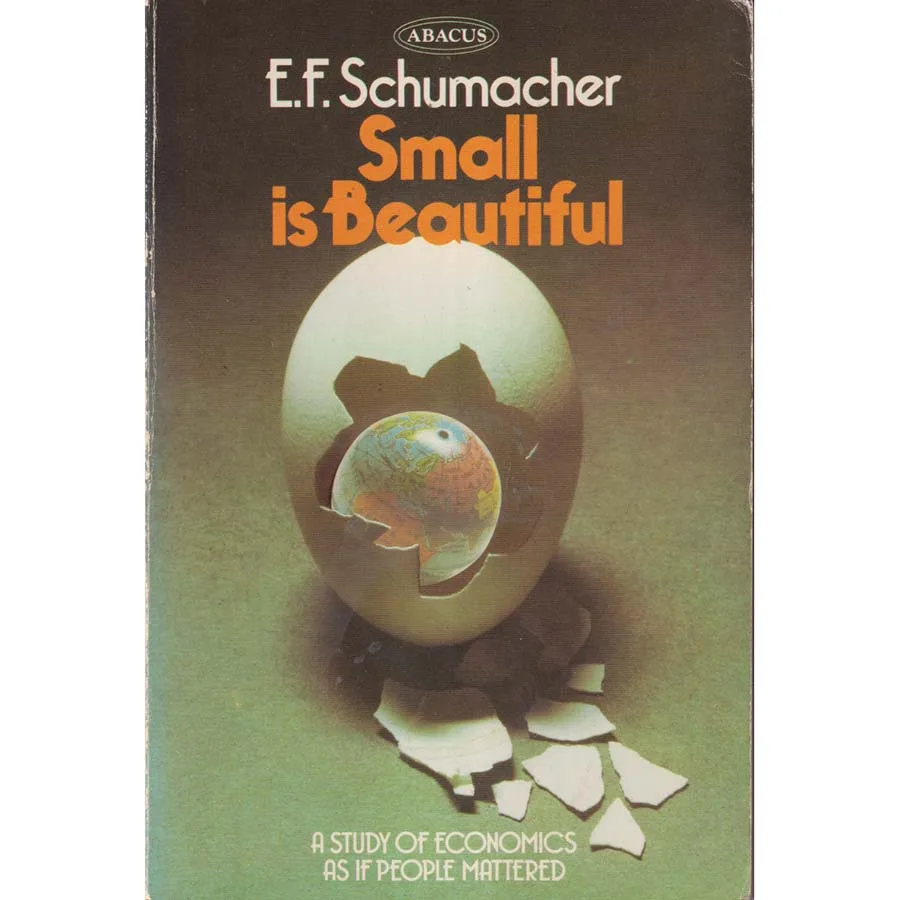
Publisher: Abacus
Format: Paperback
ISBN: 0349131384
Economics is a curious discipline. It has developed an extraordinary collection of theories, formulas and impressive-looking graphs to explain why everything should work perfectly, provided human beings stop behaving like human beings. Unfortunately, people continue insisting upon eating, working, having families, enjoying themselves and occasionally objecting when their entire communities are sacrificed in pursuit of improved productivity figures. E. F. Schumacher thought this arrangement deserved a little reconsideration.
Small Is Beautiful: A Study of Economics as if People Mattered (1975), published by Abacus, is one of the most influential and thought-provoking works of economic and environmental philosophy of the twentieth century. First published in 1973, it challenges the comfortable assumption that bigger businesses, faster growth, greater consumption and ever-increasing industrial output must automatically represent human progress.
Schumacher, an economist with the unusual habit of considering what economic activity was actually supposed to achieve, argues that societies have become dangerously obsessed with size, efficiency and material accumulation while neglecting the welfare of the people and communities supposedly benefiting from all this magnificent progress.
His central proposition is deceptively simple: perhaps an economy should exist to serve human beings rather than requiring human beings to organise their entire existence around the demands of the economy.
It was a rather radical suggestion, particularly in a world where governments and industrialists had spent decades congratulating themselves whenever the figures became larger, regardless of whether ordinary people were becoming any happier.
Schumacher explores the problems of uncontrolled economic growth, environmental destruction, excessive dependence on fossil fuels and the increasingly impersonal character of modern industrial society. He advocates appropriate technology, local enterprise, sustainable development and economic arrangements that recognise the importance of meaningful work and human dignity.
One of his most enduring ideas concerns the distinction between treating natural resources as income and recognising them as irreplaceable capital. Burning through the planet’s finite resources while congratulating ourselves on economic success, he suggests, is rather like selling all the furniture to pay the household bills and then declaring that the family finances have never looked healthier.
His arguments also question the obsession with enormous institutions, centralised systems and technologies that become so complicated that the people they are intended to assist can no longer understand or control them.
Despite its serious subject matter, the book is wonderfully readable, combining economic analysis, philosophical reflection and a refreshingly humane perspective on the business of civilisation.
More than half a century after its original publication, Schumacher’s concerns about sustainability, consumption and the human consequences of economic growth remain remarkably relevant.
Condition: Good. This 1975 Abacus edition is a previously owned copy showing ordinary signs of age, reading and handling, but remains ready to introduce another generation to the possibility that perpetual expansion might not be the answer to absolutely everything.
Offered by Crappy Old Books, a small independent bookselling enterprise that has, entirely by accident, embraced Schumacher’s philosophy of modest scale, resource conservation and finding useful purposes for things that already exist.
A fascinating and influential classic for readers interested in economics, environmentalism, politics and the revolutionary notion that making life better might be more important than simply making everything bigger.
Small is beautiful, apparently. Which is reassuring news for anyone operating a business without a multinational corporate headquarters.
Keep browsing: See more Academic books Other books by EF Schumacher